Business
Protocol of Disagreements: how to object under a contract
A protocol of disagreements records objections to someone else's draft contract before it is signed. We look at when it is mandatory, what to write in it and how to act if the counterparty does not agree with the amendments.
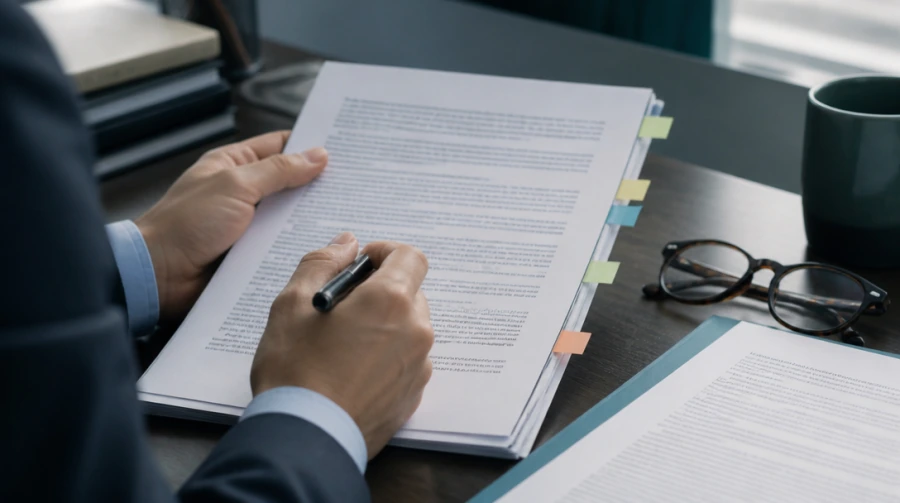
The situation is typical: the counterparty sends its draft contract, the terms are one-sided, and time is short. Signing as is is risky, asking for a rewrite may cost you the deal. This is where a protocol of disagreements comes in: it lets you state your disagreement on specific clauses and continue negotiations on paper.
The article covers how a protocol of disagreements differs from a protocol of reconciliation, which details and table make it workable, and how to formulate objections on deadlines, payment and liability in supply, construction, services and lease. Separately, the procedure for sending the document, actions after the counterparty's refusal and the mistakes that strip the protocol of its effect.
Protocol of Disagreements: what this document is and when you cannot do without it
A protocol of disagreements is a document by which the party that received a draft contract notifies of its disagreement with certain terms and proposes its own wording. In its legal nature it is not a separate transaction but a form of response to an offer: under the Civil Code of the Republic of Kazakhstan, a reply agreeing to conclude a contract on different terms is deemed a refusal of acceptance and a new offer. That is, it is a written counter-proposal on the terms of the future contract.
The protocol is drawn up at the conclusion stage, before the main text is signed. It allows disputed wording to be resolved without oral negotiations and leaves a record of which terms were changed and at whose initiative. If the contract has already been signed, it does not apply — an addendum applies instead.
- a draft contract with terms unfavourable to one party has been received;
- the counterparty insists on its own jurisdiction or an arbitration clause;
- the contract has gaps on deadlines, scope and acceptance procedure;
- the liability of the parties and the termination procedure need to be amended;
- your own version of the disputed clauses needs to be fixed before signing;
- a party disagrees with the wording of certain terms and issues a counter-offer.
Protocol of disagreements or protocol of reconciliation: how they differ and which to choose
The difference lies in who sent their version first and what has already been agreed. Having received a draft contract and wishing to change the terms, a protocol of disagreements is drawn up: your own version rejects the offer. The protocol therefore acts as a counter-offer.
If the counterparty sent the protocol of disagreements and you are prepared to accept some of the comments, you respond with a protocol of reconciliation of disagreements. In it, the disputed terms are recorded in your version, the agreed clauses are shown, and the final text of the contract is formed. This is a continuation of the dispute until the versions coincide.
- a protocol of disagreements is drawn up when you reject the initial draft and propose your own terms
- a protocol of reconciliation of disagreements is drawn up in response to a protocol of disagreements or another disputed version
- both documents state the contract details, the disputed clauses and each party's version
- the agreed clauses are expressly marked so as not to return to them in correspondence
- the protocol is signed by the same persons and in the same manner as the contract itself
- the final version of the contract is deemed accepted when the parties have signed the agreed text without comments
What to write in a protocol of disagreements: structure and mandatory details
A protocol of disagreements is drawn up when the draft contract is accepted in general, but certain terms require amendment. The document must be drafted so that it can be evidenced and used in negotiations. The structure follows the logic: who, with whom, under which contract and what exactly is not accepted.
The preamble repeats the parties' details from the contract: names, IIN or BIN, information on the representatives and the basis of their authority, the date and place of drawing up. The contract and its subject are then stated. In the main part, it is convenient to set out the terms in a table: the counterparty's version, the disputing party's version and a brief justification with a reference to a legal norm or the party's interest. This shows exactly what is being changed and what the objection is aimed at.
- the name of the document and the date of drawing up;
- the parties' details with IIN or BIN and information on the representatives;
- the name and date of the contract to which the disagreements relate;
- a table: clause of the contract, counterparty's version, disputing party's version;
- signatures of authorised persons and their names in full;
- attachments: powers of attorney, approval sheets, correspondence.
Protocol of disagreements: a sample table for disputed contract terms
The disputed terms are set out in a table in the protocol of disagreements: it shows what the counterparty proposes and what the objecting party is prepared to accept. Each row needs a ready wording, not a general disagreement.
The table has three mandatory columns: the counterparty's version of the clause, the objecting party's version, and a brief justification with a reference to a legal provision or a business interest. The justification is written in one sentence: what is unacceptable and why the proposed wording removes that concern.
The example is built on a mirror comparison: the other party's text on the left, ours on the right. The version of the clause must be complete and self-contained so that it can be transferred into the contract without further negotiation.
- split the table into the columns "Clause", "Counterparty's version", "Our version", "Justification";
- in the "Our version" column, give the full text of the clause, not a note saying "we object";
- keep the justification to one sentence, without emotion or judgements about the counterparty;
- do not duplicate clauses that suit both parties — only the disputed ones;
- keep the numbering of the original contract so that the protocol can be easily compared against it;
- check that the alternative wording does not contradict other terms of the contract.
| Clause | Counterparty's version | Objecting party's version | Brief justification |
|---|---|---|---|
| Payment period | Payment within 60 calendar days | Payment within 30 calendar days | Shortening the period evens out the cash-flow gap |
| Liability for delay | Penalty for each day of delay | Penalty for each day of delay, but not more than 10% of the debt amount | The cap is proportionate to the possible losses |
| Jurisdiction | At the location of the counterparty | At the location of the defendant | Standard jurisdiction rule under the Civil Procedure Code of the Republic of Kazakhstan |
| Unilateral termination | Right to terminate at any time without notice | Right to terminate with 15 calendar days' notice | Allows time to prepare for the end of obligations |
| Acceptance procedure | Deemed acceptance in the absence of a reasoned refusal | Acceptance by a certificate signed by both parties | Rules out hidden defects after signing |
The wording in the right-hand column is carried over into the contract verbatim; the reasoning serves as an explanation, not as part of the contract.
How to object on deadlines, payment and liability in a protocol of disagreements
A protocol of disagreements covers deadlines, payments and liability. Each amendment turns the document into a counter-offer which the counterparty is entitled to reject. Objections must be legally enforceable.
Deadlines are tied to real events: delivery after prepayment, payment after a certificate, a stage after data is handed over. Wording such as "within a reasonable time" and "as and when ready" does not allow the moment of delay to be determined. The event from which the period runs and the procedure for extending it in the event of counter-delays are specified.
- "Payment within 30 days of signing" — replace with payment after the certificate is signed in the absence of a reasoned refusal.
- "Liability for any losses" — limit to direct losses and a pre-agreed cap.
- "Delivery within a reasonable time" — specify a calendar deadline from the date of prepayment or handover of the specification.
- "The contractor is entitled to engage third parties without approval" — keep the right, but subject to notifying the customer.
- "The customer accepts the works without comments" — introduce a period for a reasoned refusal and the procedure for sending it.
| Contract section | Typical wording | What to propose in the protocol |
|---|---|---|
| Deadline | "within a reasonable time" | A calendar date or the event from which the period runs |
| Payment | "100 per cent prepayment" | Staged payment after acceptance of each stage |
| Acceptance | "deemed accepted without comments" | Deadline for a reasoned refusal and the procedure for sending it |
| Liability | "compensates all losses" | Direct losses only, within an agreed cap |
| Amendment | "the terms may be changed unilaterally" | Amendment by written agreement of the parties |
The wording is provided as a guide; the final text is tied to the subject matter of the specific contract.
A protocol of disagreements is not a dispute for the sake of dispute, but a way to record your position before signing. If it is ignored, the disputed terms will be interpreted as the counterparty drafted them.
Protocol of disagreements to a supply contract: what to look at in Almaty
A supply contract contains more disputed terms than other transactions: its essence is the transfer of goods with a name, quantity, assortment and quality. That is why a protocol of disagreements more often concerns fixing these characteristics. The counter-document must contain clear wording of the terms.
The main disagreements centre on acceptance. If acceptance is carried out by the number of packages without opening them, or against a delivery note without inspecting the contents, the risk of latent defects remains with the buyer. In the protocol, acceptance by quality and quantity is proposed with an inspection, a report where discrepancies arise, and notice to the supplier before signing documents without comments.
- Assortment: fix specific names and characteristics rather than a reference to the supplier's price list or a sample
- Quality: tie it to a specific standard, technical regulation or agreed parameters, and separately stipulate latent defects
- Delivery deadlines: break them down into periods, stating the volume of each batch and the procedure for shipping schedules
- Acceptance: provide for inspection of the contents, the deadlines and procedure for summoning the supplier, and the form of the discrepancy report
- Documents: determine which transport and accompanying documents confirm performance and serve as the basis for payment
- Amendments: state that the contract applies as amended by the protocol, and record the procedure for agreeing further changes
Protocol of disagreements to a works and services contract: how not to miss acceptance and payment
A protocol of disagreements to a works and services contract is a response to an offer proposing to change certain terms. The document cannot be drafted as correspondence: the terms set out in it become a counter-offer and determine the terms on which the contract will be concluded.
The scope and content of the works or services require objections first. In a works contract, describe what is handed over and by what result, what materials are used and which party provides them, and how changes in scope are formalised. In services, fix the list of actions, the result and the contractor's reporting. Vague wording such as "as instructed by the customer" without limits makes it difficult to prove that the work was not performed in full.
- The scope, composition and result of the works or services, and the procedure for amending the assignment.
- The start and end dates and any interim stages.
- The procedure for delivery and acceptance, the inspection periods, and the form of a reasoned refusal.
- The warranty period, the scope of warranties and the procedure for remedying defects.
- The advance payment, the payment stages, and the link between payment and signing of the acceptance certificate.
- The liability of the parties and the procedure for dispute resolution.
Protocol of disagreements to a lease agreement: objections on the rate, repairs and return
A protocol of disagreements to a lease agreement is needed when the landlord's draft does not suit the tenant. The protocol opens negotiations on the disputed terms. Without it, signing means agreeing to all the wording, including one-sided advantages for the other party.
Disagreements over rent concern not only the rate but also the procedure for changing it. A wording giving the landlord the right to revise the rate unilaterally or 'at market value' is dangerous. The objection fixes the mechanism: the frequency of revision, written notice and the tenant's right to refuse the new terms. The rate is tied to a fixed amount or a verifiable indicator.
- The rate and the procedure for changing it: a fixed amount, the notice period, the right to refuse on revision.
- Current and major repairs: the allocation of obligations and written consent to improvements.
- Compensation for inseparable improvements and the conditions for setting them off.
- Return of the premises: the deadline, calling a representative, photographic recording, the acceptance certificate.
- The consequences of the landlord evading acceptance of the property.
- The procedure for dispute resolution and the applicable law under a lease agreement.
How to send a protocol of disagreements to the counterparty and what to do afterwards
The protocol of disagreements is drawn up as a separate document: the clauses of the agreement and the proposed wording are set out line by line. It is signed by an authorised person and sent to the counterparty together with the signed agreement or before it is signed. It is important to record the moment the document is sent and received.
Choose a method that leaves a provable trail: a registered letter with acknowledgement of receipt and an inventory of contents, courier delivery with a delivery note, or an electronic document management service with a confirmed signature. Keep the receipts, inventories, and dispatch and delivery reports. If you sign the agreement at the same time as sending the protocol, add the note 'with a protocol of disagreements' when signing and state in the protocol that it is an integral part of the agreement.
- Identify the disputed clauses and prepare your own wording for each of them.
- Have the protocol signed by an authorised person and attach it to the agreement or to a covering letter.
- Send the document by a method that confirms the date of dispatch and delivery.
- Keep the receipts, inventories of contents, notifications and electronic delivery confirmations until the counterparty responds.
- State the desired response deadline in the covering letter; under the Civil Code of the Republic of Kazakhstan, silence on the part of the counterparty is not considered acceptance.
- If the counterparty refuses or stays silent, send a repeat demand and record your position in writing.
If the counterparty has rejected the protocol of disagreements: what to do next
Rejection of a protocol of disagreements is not a dead end. Under the Civil Code of the Republic of Kazakhstan, a reply agreeing to conclude a contract on different terms is treated as a refusal of acceptance and a new offer. This means you have put the disputed terms forward again, and negotiations continue. Silence does not sign the contract: without acceptance in the required form, the contract is not concluded.
What to do depends on whether the deal is needed and on what terms. You can return to negotiations and agree on the disputed clauses. You can sign the contract with a protocol of agreement of disagreements, accepting part of the counterparty's amendments. The extreme option is to walk away from the deal if the terms are unacceptable.
- Continue negotiations and put the new wording of the disputed clauses in writing.
- Sign the contract with a protocol of agreement of disagreements, accepting part of the amendments.
- Walk away from the deal if the key terms are unacceptable to you.
- Go to court if there are grounds provided for by law.
- Keep all correspondence, invoices and documents confirming the course of the negotiations.
- Check under the Civil Code of the Republic of Kazakhstan which terms are essential for this contract.
Typical mistakes in a protocol of disagreements and how to avoid them
References to specific clauses of the contract are checked first. The wording "clause 4.2 to be set out in the wording according to the annex" without the text itself creates no certainty. A protocol that merely rejects the counterparty's wording does not record the will of the objecting party and can be challenged as not agreed.
Vague wording such as "exclude unfair terms" has no force. A term is either excluded entirely, or set out verbatim in your own wording, or supplemented with a new clause with ready text. Mixing two wordings in one clause is a common mistake: the disputed term and the proposed replacement must be clearly separated.
- State the number and exact text of each clause of the contract you object to.
- Set out your term verbatim rather than describing its meaning in general words.
- Do not mix the counterparty's wording and your own in one clause — keep them separate.
- Observe the deadline for replying to the offer, if one is set, and record the date the protocol was sent.
- Keep evidence of sending and receipt: notification, delivery confirmation, email correspondence.
- Check the final text of the contract against the protocol so that the agreed amendments are not lost on signing.