Cargo lost or damaged
Shortage, spoilage, total loss of a consignment. We work out who is liable at which stage and file the claim within the time limit.
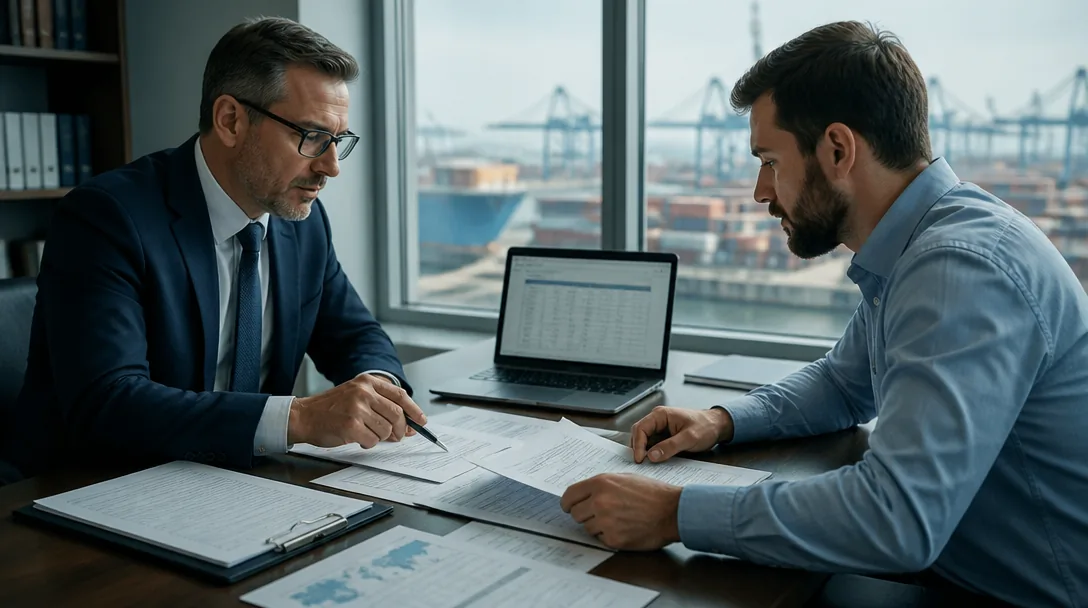
We work with cargo owners, freight forwarders and transport companies
Caspian routes, multimodal carriage and transit through ports
We read the bill of lading and charter before signing — that is where liability limits and deadlines are
We handle claims against carriers, ports and terminals
We review insurers' refusals on cargo and challenge them
We support foreign trade contracts with a transport element

Send us the bill of lading, the carriage contract and the acts — we will tell you who is liable in your situation, which time limits are already running and what amount you can expect. Review of the documents is free.
Message us on WhatsAppShortage, spoilage, total loss of a consignment. We work out who is liable at which stage and file the claim within the time limit.
We read the documents before shipment: limits of liability, clauses, applicable law, dispute resolution procedure.
The carrier or terminal has charged for demurrage. We check the laytime calculation and whether the charges are justified.
The vessel was late, the cargo arrived after the season or after the deadline under the contract. We work out liability and losses.
Who is liable in multimodal carriage if the cargo was damaged at the junction between modes of transport and the boundaries of liability are blurred.
The insurer refused, citing exclusions or a breach of the carriage terms. We challenge the refusal and pursue payment.
The cargo is held at a port or terminal because of debts, documents or disputes. We work to secure its release.
We draft and amend delivery terms in foreign trade contracts: the basis, the point at which risk passes, insurance, and liability for failure to ship.
The review of the document set is free. In maritime carriage, the deadlines for a claim and for court proceedings are short, so the first thing we tell you is the date after which a claim can no longer be brought.
Cost
One-off tasks are priced by the volume of documents, and disputes by the amount claimed and the place of resolution. Foreign applicable law and proceedings abroad are priced separately.
| Service | What is included | Cost |
|---|---|---|
| Review of the document set | Who is liable and which deadlines are running | free of charge |
| Legal opinion on carriage | A written analysis of liability and risks | from 55,000 ₸ |
| Review of the bill of lading and contract | Exceptions, limits, applicable law | from 60,000 ₸ |
| Claim against the carrier | Preparation with calculation and annexes | from 80,000 ₸ |
| Calculation of demurrage and detention | Review of laytime and charges | from 70,000 ₸ |
| Dispute over shortage and damage | Conduct of the case through to decision | from 230,000 ₸ |
| Dealing with an insurer's refusal | Challenge and claim for payment | from 140,000 ₸ |
| Release of detained cargo | Urgent work with the port and terminal | from 190,000 ₸ |
| Transport terms of a foreign trade contract | Basis, risks, insurance, liability | from 100,000 ₸ |
| Dispute with a freight forwarder | Allocation of liability at each stage | from 180,000 ₸ |
| Support with shipments | Ongoing review of transaction documents | from 210,000 ₸/month |
| Dispute abroad | Coordination with foreign lawyers | by agreement |
The ranges are indicative and do not constitute a public offer. State duty, surveyor inspections, expert examinations, translations and notarial acts are paid separately.
Claims arising from carriage have short deadlines, and some of them are pre-action claim deadlines. A missed deadline closes the door to a dispute regardless of who is in the right.
It is not just a receipt for the cargo: it sets out the carrier's limits of liability, reservations about the condition of the cargo, the applicable law and the place where disputes are resolved.
The carrier's notes on the condition of the packaging and cargo on acceptance decide half of the future dispute. A clean bill of lading and a bill of lading with reservations are two different positions.
In multimodal carriage it is important to establish at which leg the damage occurred: this determines both the defendant and the applicable rules.
Reports, photographs, a surveyor's inspection, weighing. The inspection is carried out on delivery of the cargo — afterwards it is almost impossible to prove its condition at the time of handover.
The value of the cargo, inspection and storage costs, losses from a failed delivery. We separately check whether the carrier's limit of liability applies.
To the carrier, the freight forwarder and the insurer — depending on what the analysis shows. Often the claim is sent to several addressees at once.
In court or in the manner agreed by the parties. If the applicable law is foreign, we coordinate the work with lawyers in the relevant jurisdiction.
Send the bill of lading and the reports via WhatsApp — we will tell you today who to claim against and by what date.
Team
We handle a case from start to finish with the same team: you always know who is dealing with your matter and who to contact.

Lawyer for civil cases
Handles disputes over real estate, inheritance, contracts and transactions. Supports transactions from document review through to registration of title.

Lawyer for financial and motor vehicle disputes
Works with banks, insurers and debt collectors, handles recovery and bankruptcy cases, and defends drivers in administrative matters.

Lawyer for family and social matters
Handles divorces, division of property, alimony and disputes over children, as well as employment, pension and social issues.
Lawyer for corporate law
Supports company transactions, arranges shares and corporate agreements, handles disputes between participants and reorganisation.

Tax lawyer
Challenges notifications and inspection reports, handles tax disputes in court, supports inspections and recovers overpayments.

Construction and contract lawyer
Reviews contract agreements, estimates and acts, handles disputes over quality and scope of works, supports acceptance of facilities.

Intellectual property and IT lawyer
Protects copyright and trademarks, drafts contracts for IT teams and handles rights to products and code.

Bankruptcy and debt recovery lawyer
Handles bankruptcy and rehabilitation procedures, recovers receivables, defends directors against subsidiary liability.
Practice
Details have been changed and anonymised: the content of the case is protected by professional privilege.
Useful information
Cargo from the port of Aktau or Kuryk did not arrive on time, arrived damaged or did not arrive at all, and in correspondence the carrier refers to a storm, force majeure and its limited liability. At the same time the port issues an invoice for vessel idle time, and the cargo owner signs documents so as not to lose what remains of the cargo. In such a situation every signature and every letter works either for the claim or against it.
The main mistakes made by cargo owners are almost always the same: the condition of the cargo is recorded too late, the bill of lading is accepted blindly, demurrage is paid to the port without analysing the causes of the idle time, and the insurer learns of the incident too late. A maritime lawyer comes in at precisely this stage, to gather the evidence before it disappears and to determine correctly to whom and on what basis the claim should be brought.
Cargo from Almaty that has gone through the Caspian may get stuck in Aktau or Kuryk, arrive damaged or not arrive at all. In such a situation the carrier often refers to a storm, the actions of the port or "force majeure", and the cargo owner is left without compensation. What has to be dealt with is not general arguments but a specific set of documents: the bill of lading, a statement of damage or shortage, notice to the carrier, correspondence with the agent at the port.
A maritime lawyer is needed here not for "negotiations in general", but to record the facts in time and to classify the dispute correctly: whether this is loss, damage or delay of the cargo. That determines which rules of merchant shipping apply, which deadlines must not be missed and what evidence must be gathered before the traces disappear.
| Situation | Key document | What we record |
|---|---|---|
| Cargo lost | Bill of lading, port report | Who the holder is, where the cargo was unloaded |
| Cargo damaged | Inspection report, surveyor | Nature and extent of damage |
| Cargo detained | Notices, correspondence | Reason for the delay and the port's demands |
| Carrier is silent | Claim and proof of delivery | Date and fact of the application |
Without these documents, the dispute becomes one word against another.
Maritime carriage in Kazakhstan is governed by the Law of the Republic of Kazakhstan on Merchant Shipping. This is the main document a maritime lawyer relies on when handling a dispute between a cargo owner, a freight forwarder and a carrier. The Law sets the framework: who is considered the carrier, which documents confirm the contract, how risk is allocated between the parties.
For a cargo owner from Almaty, this framework matters because it determines the scope of rights in case of loss, damage or delay of cargo. The freight forwarder is responsible for organising carriage, the carrier — for the cargo itself from the moment of acceptance until delivery. If the vessel sails across the Caspian and through the port of Aktau, the dispute is still resolved under Kazakhstan law.
The bill of lading confirms acceptance of the cargo by the carrier and sets out the terms of carriage, so a maritime lawyer reads it in full first, not just the header. They look at what exactly is recorded about the cargo: number of packages, weight, marking, condition of packaging, type of cargo, port of loading and discharge, name of the carrier and date of acceptance.
The carrier's reservations and discrepancies between the bill of lading and the actual consignment are checked separately. If the document bears a note about damage, shortage or disputed condition of the cargo, the carrier is shifting part of the risk onto others in advance, and the dispute moves towards what happened before loading. When discrepancies come to light on delivery of the cargo, it is the bill of lading that determines who proves what.
The legal period during which the carrier is answerable for the cargo begins when it is accepted and ends when it is delivered. In practice this means that if the cargo has disappeared, been damaged or delayed at the port or on the vessel, the cargo owner's claim is addressed to the carrier, not only to the port or the freight forwarder. A maritime lawyer in Almaty first establishes whether the particular incident falls within that time frame.
The liability of a sea carrier is not unlimited. It may be limited by law and by the bill of lading: it is usually not possible to agree to terms below the limits set by law, but the parties often include additional conditions in the document that narrow the cargo owner's options. This is critical for claims: the wording determines whether it will be possible to recover the full value of the lost cargo or only part of it.
Demurrage is a charge for keeping a vessel idle beyond the agreed loading or unloading time. It is charged by the port, terminal or carrier under the terms of the contract of carriage by sea, the port tariffs or port custom. The basis is usually set out in the bill of lading, the charter party or the loading order. If the cargo was delayed through the fault of the cargo owner, the invoice is issued to them.
A demurrage dispute almost always comes down to the facts: who provided the vessel and when, how long loading took, whose inaction caused the idle time, which documents recorded the time. The following documents are checked:
Claims arising out of the carriage of goods by sea are subject to a shortened limitation period — one year. This means that the cargo owner, freight forwarder or transport company has exactly one year to submit a claim for damages to the carrier or the port and, if the dispute is not resolved, to go to court. Missing this period nullifies even a strong position: loss of cargo, damage or delay may be confirmed by the bill of lading, reports and correspondence, but if the defendant raises the objection, the court will dismiss the claim solely on the ground of limitation.
A maritime law lawyer first checks when this year began to run and what has been done to interrupt, suspend or restore it. While the period has not expired, the party has time to gather documents, record the losses, send a pre-action claim and prepare the statement of claim. It is also worth remembering that the running of the period depends on a specific date — the day the cargo was delivered, the day the loss became known, or another event.
Cargo insurance and a claim against the carrier run in parallel: the insurer pays under the contract and acquires the right to recover from the party at fault, but the cover amount is often lower than the actual loss — the shortfall is then recovered from the carrier, and here a sound maritime jurisdiction is decisive. In Kazakhstan on the Caspian, cargo often moves under a bill of lading with reservations, and the insurer demands documents the cargo owner simply does not have. A maritime lawyer brings the calculation of losses, the insurance payment and the right of claim into a single justified recovery.
The claim must be filed so that the insurer does not refuse on formalities and the carrier does not close itself off with a liability limit. A lawyer checks that the documents are complete and synchronises the deadlines: the notice, the inspection of the cargo, the calculation of loss, the responses of the port and the carrier. If the compensation is insufficient, the difference is claimed from the carrier under the bill of lading, and the dispute is pursued through a court enforcement officer already in Kazakhstan.
A dispute arising from carriage by sea requires a full set of written evidence. First of all, prepare the bill of lading: the original or a copy, all copies, including the one retained by the carrier, and its reverse side with the terms. If the cargo moved under a sea waybill or another transport document, attach that as well. Check the marks of the port of loading and unloading, the reservations as to the condition of the cargo and the details of the consignee.
Collect the reports: commercial act, act of damage or shortage, act of vessel demurrage, as well as the survey report and tally sheets. Correspondence with the carrier, port and freight forwarder will be useful, including letters on demurrage and notices of delay, calculations of losses and demurrage, insurance documents. The more complete the set, the more precise the position in the dispute.
What else to attach to the application:
A shipping law lawyer usually handles a dispute over the application of merchant shipping rules: checks the bill of lading, charter party, limitation periods, allocation of liability between the carrier, port and cargo owner. A maritime lawyer in the broad sense comes in earlier, when the cargo has only just been delayed or lost and the entire line of defence needs to be built from claim to enforcement.
In practice this means support at several levels. A shipping law lawyer prepares the legal position, while a maritime lawyer handles correspondence with the carrier and port, files a claim in a court of Kazakhstan and secures actual recovery through a private or state court enforcement officer.
Loss, damage and delay of cargo differ not only in their consequences, but also in which set of documents must be submitted to the court, and by whom. Below are three typical situations faced by cargo owners and freight forwarders in Almaty on shipments across the Caspian.
The general rule is simple: whoever relies on a fact must prove it. But once the cargo has been accepted for carriage under a bill of lading, the burden shifts: the carrier has to explain why the cargo was not delivered intact or on time.
| Situation | Who proves it | Key documents |
|---|---|---|
| Loss of cargo | The carrier — that the loss was not its fault | Bill of lading, act of non-arrival, discharge records |
| Damage to cargo | The cargo owner — the fact and extent of the damage | Inspection report, surveyor's report, photos, bill of lading |
| Delay in delivery | The cargo owner — the delay; the carrier — that it was justified | Notice of readiness, timesheet, correspondence, bill of lading |
The nature of the cargo is stated in the bill of lading and affects the set of evidence required.
The most costly mistake is collecting evidence too late. Notice to the carrier of loss, damage or delay of cargo must be sent as soon as the problem becomes known, and proof of delivery must be kept: an acknowledgement of receipt, a postal receipt, a reply to the letter. If you limit yourself to phone calls and messages in a messenger without any record, it will be difficult to prove that the carrier knew about the claim.
The second group of mistakes concerns documents and deadlines. Do not sign a discharge or delivery act without reservations about shortages, damage and signs of tampering — later such an act will become the main argument against you. Do not pay demurrage without checking the grounds on which it was charged and the time of demurrage according to the timesheet, and do not delay filing a claim: claims arising from carriage by sea are subject to a one-year limitation period, and missing it closes the dispute for good. What most often undermines the cargo owner's position:
A dispute over cargo that travelled through Aktau or Kuryk is more complex than an ordinary transport case. Here it is almost always multimodal carriage: by sea to a Kazakh port, then by rail or road to Almaty or another city. Loss or damage could have occurred on any leg of the route, and the question of who is liable is decided by the documents of each stage.
The second layer is the foreign port of loading. The bill of lading is often issued by a foreign carrier, agent or liner representative, and the applicable law and place of dispute resolution are stated in the document itself. Until the law and jurisdiction are determined, any claim may be brought against the wrong party. The experience of a maritime lawyer in such cases is the ability to break the route down into stages and understand exactly where the cargo left the carrier's control:
The most costly thing in a maritime dispute is not the loss itself but time: while negotiations are ongoing and documents are being signed, traces of damage to the cargo disappear and the limitation period for the claim runs out. The decision to instruct a maritime law lawyer is taken not after the carrier's refusal, but in the first days after the incident.
Reviews
Equipment worth 94 million arrived with corrosion, and the carrier pointed to a clean bill of lading. Asel got involved straight away, the survey was carried out on time, and we received the insurance payout in four months. After that the insurer dealt with the carrier itself
Service: Maritime lawyer in Almaty
We were billed demurrage of 11.4 million. They recalculated it under the contract, excluding weekends and terminal downtime, and it came down to 3.6. I would have just paid it.
Service: Maritime lawyer in Almaty
My cargo was held up at the port, the carrier kept feeding me promises, I didn't know where to run anymore. Found this firm by reviews, went for a consultation. They took me without an appointment, listened, looked at the documents. Thanks, they figured it out fast and explained clearly, I even wrote down what to do next. Very happy I didn't have to go in circles. Of course I'd have liked them to answer the first call right away, but after that everything went smoothly
Service: Maritime lawyer in Almaty
Thank you for the review, Irina. We are glad we could help and that the analysis was clear. As for the calls, we will take it on board so that we respond faster.
I came to them with a shortage of bulk cargo, and the carrier kept blaming natural loss and insisting that was just how it is. At first I tried writing to them myself, but I only got brush-offs, so I decided to look for a lawyer. It turned out that the cargo was measured by different methods at loading and unloading, and that was what caused the whole shortage. They laid it all out for me document by document and explained exactly where the discrepancy was. After that everything went more calmly and I stopped worrying. The carrier resisted at first, but then agreed. They recovered 5.9 million. I am glad I got in touch, I would never have untangled this myself
Service: Maritime lawyer in Almaty
The cargo arrived damaged, and the freight forwarder said he was only the organiser and not responsible for anything. Under the contract it turned out he had undertaken to deliver it, and he compensated the full 22 million himself. Aigerim laid it all out, I just had to wait a couple of days for an answer and bring in some documents, but the result was worth it
Service: Maritime lawyer in Almaty
Thank you for writing. We are glad the matter was resolved and the forwarder compensated the amount. We apologise for the wait for an answer.
The insurer refused, citing the packaging. We gathered evidence that the packaging was normal for this kind of goods and the problem was the securing, and they paid out 31 million after the second claim
Service: Maritime lawyer in Almaty
Thank you for the review. Good that we managed to prove the cause and secure the payout.
I came in when the cargo was being held at the terminal over our own forwarder's debts, and I had no idea what to do at all. They got it released in eight days and had the storage charges for that period waived
Service: Maritime lawyer in Almaty
I spent six months exchanging letters with the carrier, but I did not know the limitation period was so short. Sanzhar told me about it in time. In the last few weeks we made it. We got 68 per cent under a settlement. Thank you, you helped a lot
Service: Maritime lawyer in Almaty
They explained that our delivery basis did not match the actual logistics and that the wrong party was insured. Asel redid everything, and twelve shipments went through cleanly. I did have to wait a couple of days for an answer, but that is a minor thing
Service: Maritime lawyer in Almaty
When our cargo got stuck, I went round several lawyers and almost none of them spoke plainly about the deadlines. Here they told me about the deadlines straight away, and that turned out to be more important than everything else. I did not fully understand it at the time, but later it all came together. We managed to file on time, and the case got moving. Honestly, that is what saved me. Good that they told me about the deadlines right away. It turned out to be more important than everything else. Now I tell everyone I know not to delay
Service: Maritime lawyer in Almaty
They read the bill of lading carefully and found a clause on applicable law that we had no idea about. Gulnara showed and explained everything
Service: Maritime lawyer in Almaty
We had cargo that was unloaded with damage, and I didn't know what to do with the documents. First time dealing with something like this, so I was looking for a lawyer. They told me not to sign blank documents on exit but to make a note of the damage. That's what ended up solving it. Thank you so much
Service: Maritime lawyer in Almaty
We work on the transport part of our contracts on an ongoing basis, and there are noticeably fewer disputes now. I came here after one shipment was detained and we lost money and time. That's when I realised I needed a lawyer who understands transport. Everything was explained calmly, without unnecessary words. First they went through our contracts, then helped structure the documents so there would be fewer grounds for disputes. Now I get in touch for every new delivery. They respond quickly, no waffle. Since then, claims from carriers have dropped several times over. I recommend them to fellow business owners
Service: Maritime lawyer in Almaty
When the cargo arrived damaged, I was sure we would recover the full value, but I was honestly warned that the carrier's liability limit is lower than the value of the cargo and without insurance not everything would be recovered. At first it was unpleasant to hear. But it's better to know this in advance than to be disappointed later. They explained how it works and advised me to insure the next deliveries. I did. It became calmer once I understood what to expect. Now I insure everything in advance. Better to know in advance
Service: Maritime lawyer in Almaty
I came when the cargo went missing and no one admitted fault, I didn't know who to turn to anymore. Madina didn't wait to find out who was to blame, the claim was sent straight away to the carrier, the freight forwarder and the insurer. No time was lost
Service: Maritime lawyer in Almaty
Professional, without unnecessary promises. Sanzhar calmly went through everything and didn't promise the earth
Service: Maritime lawyer in Almaty
Thank you for the review. We try to work honestly and without unnecessary words.
I came when part of the cargo arrived damaged and the carrier started arguing. They organised a surveyor the same day, otherwise there would have been no way to prove it
Service: Maritime lawyer in Almaty
Thank you for getting in touch. Glad we managed to record everything in time.
Multimodal transport is a story of its own, and they understand it. They found on which leg the damage occurred
Service: Maritime lawyer in Almaty
Thank you for the review. Glad we could work out exactly where the damage occurred.
Грузім шетелде жоғалып, қайдан бастауды білмедім, сондықтан кеңес сұрап келдім. Спор шетел құқығы бойынша жүрді. Маған бірден айтып, сол жақтағы заңгерлерді қосты. Уақытты созбады, бәрі тез болды. Көмектеріңізге рахмет
Service: Maritime lawyer in Almaty
The document review is free and it really is, no one asked for money in advance
Service: Maritime lawyer in Almaty
Thank you for the review. Yes, our document review is free, do get in touch.
I came back a second time about cargo, the first time everything was resolved and I returned. They work quickly, which is the most important thing in logistics
Service: Maritime lawyer in Almaty
I came when the cargo got stuck and the contract was on fire, deadlines were pressing from all sides. They helped, we made it in time
Service: Maritime lawyer in Almaty
Blog

Delivery basis, transfer of risk and the transport part of the deal.
Read the analysis
Exclusions on packaging and carriage conditions — and what to do about them.
Read the analysis
The procedure to follow when a counterparty does not pay for a delivery or services.
Read the analysis
Liability and deadline terms that decide the outcome of a dispute.
Read the analysis
Acceptance, deadlines and recording defects — the logic is the same as in carriage.
Read the analysis
Documents against payment and control of the cargo through a document of title.
Read the analysisFAQ
The Caspian route and the sea leg in multimodal carriage. Cargo travels by sea to a port, then onward by road or rail — and the sea leg has its own rules: special documents, limits on the carrier's liability, short deadlines. Our clients are cargo owners, freight forwarders and transport companies.
Less than in ordinary contractual disputes, and some of the deadlines are pre-action: the carrier must be notified within a period counted in days after delivery of the cargo. Correspondence with the carrier does not extend the deadline. That is why the first thing we name is the date after which a claim can no longer be submitted.
It is a bill of lading without reservations as to the condition of the cargo and packaging at the time of receipt. It means the carrier accepted the cargo as externally sound, and therefore complicates its position in a dispute over damage. If the cargo is accepted with defects in the packaging, a reservation must be entered — otherwise the damage will be attributed to the period of carriage or, conversely, to its original condition.
Do not sign clean documents on delivery: discrepancies are recorded by a clause in the report. Then a surveyor's inspection with a representative of the carrier or terminal present, photographs of the packaging, seals and securing before the consignment is opened, and written notice within the deadline. Later it is practically impossible to prove the condition at the time of delivery.
Not necessarily. Limits of liability apply in carriage, and compensation is often noticeably lower than the actual value. That is precisely why cargo insurance is not an option but a way to cover the difference. We always look at the policy alongside the claim against the carrier.
It depends on which leg the damage occurred on and how the relationship with the freight forwarder is documented. A freight forwarder may be merely an organiser, or may have assumed an obligation to deliver the cargo — in which case it is liable for its safety as a carrier. The distinction is determined by the contract, not by the company's name.
It is almost always worth recalculating. Laytime runs not from the vessel's arrival but from the tender of the notice of readiness, and does not run at weekends or during periods when work is impossible for reasons attributable to the terminal. Invoices are often issued on calendar days in the expectation that no one will check.
No, such refusals can be challenged if the exclusion has been applied formally. The manufacturer's specification, the practice of previous shipments of the same goods on the same route and an expert opinion all work in your favour. In our practice, insurers reconsidered and paid in full after a second claim.
Usually not, if the cargo belongs to you and the obligations arose with another party. A demand for release is sent, pointing to the unlawfulness of the retention and to the losses that continue to accrue, while interim measures are prepared in parallel. In our case the cargo was released within eight days and the storage costs were removed.
The rules of the dispute and, often, where it is heard. We raise this straight away and coordinate with lawyers in the relevant jurisdiction, rather than finding out halfway through. Sometimes the very presence of such a clause is a reason to renegotiate the terms before the next shipment.
We look at the bill of lading, the contract of carriage, the reports and the correspondence, and tell you: who is liable, which deadlines are already running, whether a limit of liability applies and what sum you can realistically expect. That is enough to decide whether to dispute it or not, before any costs are incurred.
Contacts and maps
2GIS opens in a separate tab — the service does not allow embedding an organisation card.
Open in 2GISZoon opens in a separate tab: client reviews and ratings are there.
Open on ZoonThe first consultation is free. If the matter can be resolved without court, we will say so directly.